 Home
Home  News & Insights
  Product Suite
  Deck
Deck  About
About  Imprint
  Data Privacy
SIM 3.0: Why Decentralized Project Management is the Future of EU Digital Sovereignty


After several months of real-world development and intensive beta testing, SIM 3.0 has reached a level of stability and maturity that allows us to take a decisive step forward. We are pleased to announce our full entry into the production phase which includes shutting down our old PHP legacy system and fully committing to the new, decentralised one.
This move isn't about chasing a trend. It's a strategic shift rooted in the SOVERI principle: data sovereignty by design. Regulations like GDPR and the NIS2 directive make it increasingly clear: Organisations must not only protect data, but also maintain complete transparency, control, and accountability over its processing, access, and auditability.
Explainer
- The General Data Protection Regulation (GDPR) is a comprehensive data protection and privacy law enacted by the European Union. The GDPR is already in force and fully applicable.
- The NIS2 directive (Network and Information Systems Directive 2) is an European Union regulation that is part of the move toward digital autonomy and enhanced cybersecurity. In Austria, the NISG 2026 (Network and Information Systems Security Act 2026) was adopted by the National Council on 12 December 2025 (government draft NISG 2026). The Act implements the NIS-2 Directive and will enter into force nine months after its publication in the Federal Law Gazette, effective from the first day of the following month. Until that time, the NISG 2018 remains applicable.
- The Internet Computer is a decentralized, general‑purpose blockchain that acts as a Public World Computer, enabling canister smart contracts to run complete web services and applications entirely on-chain without traditional IT or corporate cloud providers.
The Problem with Conventional Platforms
Conventional project management platforms are predominantly built on centralized cloud infrastructures, frequently operated outside the European Union. This creates structural vendor dependencies and legal uncertainty, posing a material risk — particularly for SMEs and long-running projects. In practice, organisations relinquish control over their most critical asset: their data.
SIM 3.0 addresses these risks by design. Built on the Internet Computer, it deliberately avoids the centralised cloud model and instead, runs entirely on a decentralised blockchain infrastructure. Application logic and data are deployed together, making the system tamper-resistant, verifiable, and resilient. The result is a sovereign project management platform that ensures data control, regulatory alignment, and long-term operational independence.
From an EU sovereignty perspective, SIM 3.0 is a practical response to the need for digital autonomy.
- NIS2 alignment: NIS2 emphasizes operational resilience, availability, and risk management. Our decentralized architecture reduces single points of failure and eliminates vendor lock-in at the infrastructure level.
- European jurisdiction: By operating on the Internet Computer’s European subnet we align technical architecture with regulatory intent. Data remains under European jurisdiction and systems are continuously available by design.
- Compliance by architecture: Compliance is supported through the system's structural properties rather than enforced retroactively through complex contracts.
A Management Perspective: Control, Risk, and Responsibility
From a management perspective, the key distinction between conventional tools and SIM 3.0 is a fundamental shift in control and long-term risk.
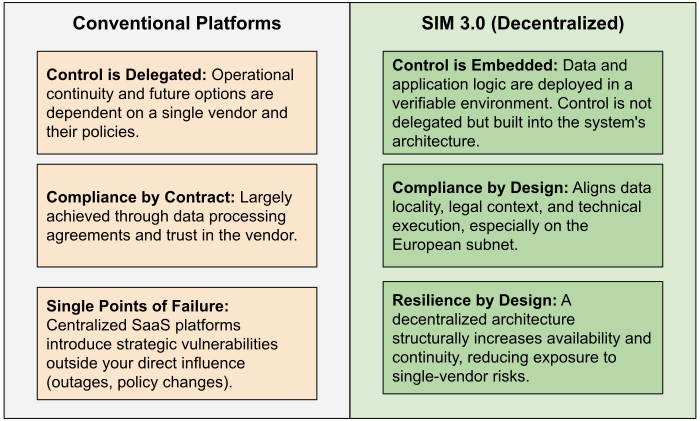
Ultimately, SIM 3.0 represents a shift in philosophy. While conventional platforms optimise for short-term efficiency, the SOVERI approach prioritises ownership, resilience, and regulatory alignment over time. The result is: fewer hidden dependencies, reduced long-term risk, and a system that becomes stronger as regulatory demands increase.
It is important to emphasise that SIM 3.0 is not as a theoretical concept, it is proven through execution — built under real commercial constraints to meet concrete operational demands.
Final Thoughts: Your Strategic Reference Point
Use SIM 3.0 as a strategic reference point to review your current project infrastructure. We encourage you to focus on:
- Ownership (Where does my data truly reside?)
- Regulatory Exposure (Am I compliant with current and also future EU laws?)
- Operational Resilience (How do I mitigate single points of failure?).
Get in touch with us and take the next step toward full data sovereignty on the web. We’re still early in this journey — and we’re excited to support you with your project.


